Data Center E-Waste Projections Underestimate Infrastructure Lifecycle Costs
Enterprise IT leaders must account for cooling, power, and networking hardware to accurately assess the environmental and operational footprint of AI deployments.
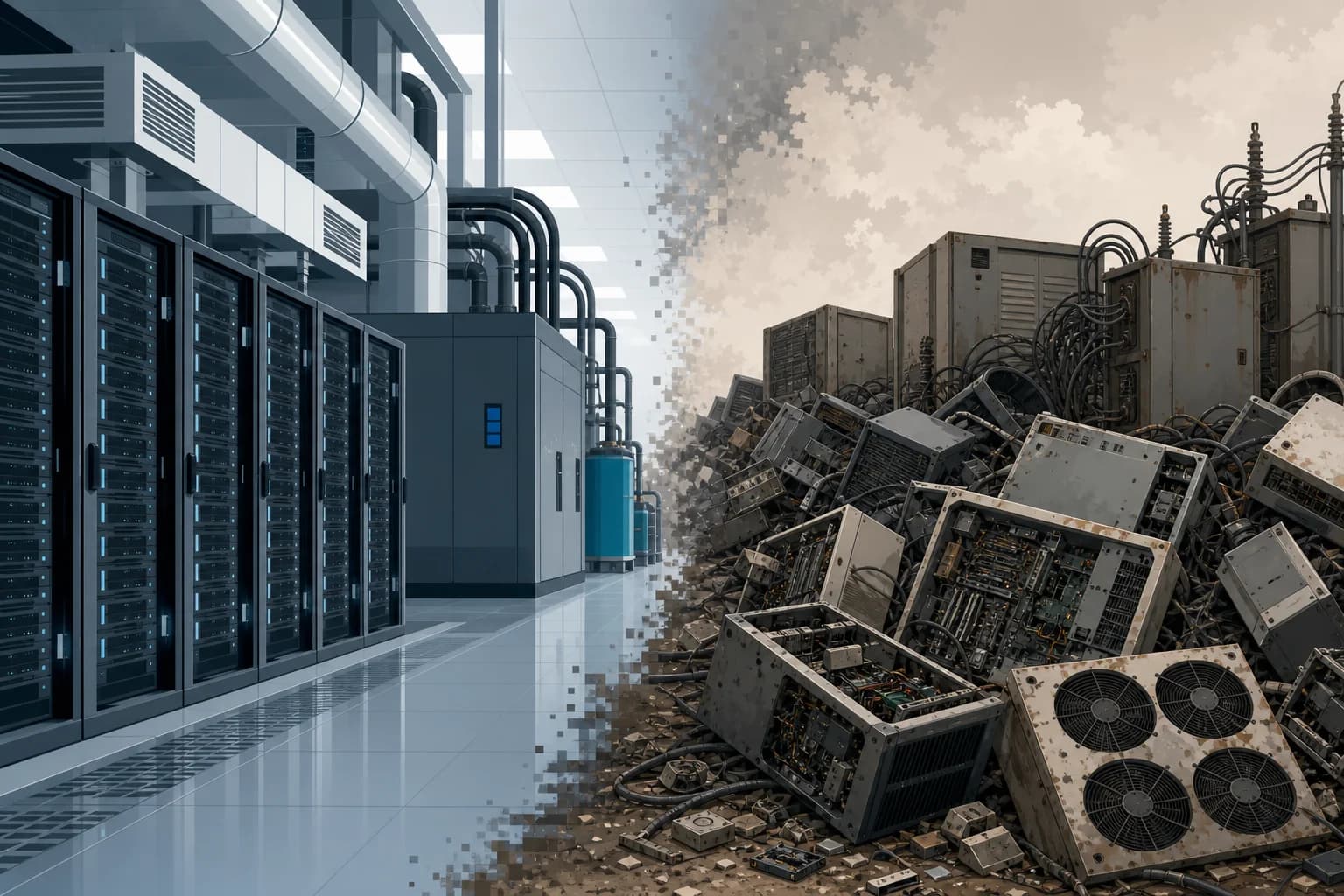
Enterprise data center operators are significantly underestimating the volume of electronic waste generated by artificial intelligence deployments by focusing exclusively on compute hardware. A report released by the Basel Action Network, an organization that monitors compliance with the United Nations Basel Convention on hazardous waste, indicates that servers and accelerators account for only 13% of a facility’s total electromechanical infrastructure.
The report identifies five primary equipment categories—networking, power distribution, storage, backup systems, and cooling—that constitute the remaining 87% of hardware mass. These supporting systems contribute approximately 70,000 metric tonnes of equipment per gigawatt of capacity, a figure largely absent from current industry environmental projections. Analysts suggest that this oversight stems from a historical focus on IT-centric hardware rather than the broader facility-level footprint required for high-density AI workloads.
The Basel Action Network estimates that by 2030, the volume of retired AI-related electronic equipment will be 40 to 60 times higher than previous academic models suggested. This projection relies on an assumption that AI infrastructure follows a 2.5 to 5-year retirement cycle, driven by the rapid generational turnover of specialized accelerators. The research forecasts total global e-waste reaching up to 211 million metric tonnes annually by 2050, with AI-specific hardware contributing between 31 and 46 million tonnes of that total.
Frank Dickson, principal analyst at Dickson Research, notes that while the hardware mass estimates are grounded in rigorous methodology, the waste tonnage projections remain subject to debate. He points out that hyperscalers have recently extended their accounting lifespans for servers to between 5.5 and 6 years, contradicting the report’s shorter replacement assumptions. These firms argue that hardware retains utility for inference and lower-intensity batch processing long after it exits frontier training clusters.
Steven Eric Fisher, an independent technology consultant, questions the report’s reliance on product release cadences as a proxy for equipment obsolescence. He observes that older hardware generations, such as the NVIDIA V100 and A100, remain active in cloud environments years after their initial introduction. Fisher further challenges the estimated lifespans for power and cooling infrastructure, noting that traditional facility equipment often remains operational for 15 to 20 years, far exceeding the report’s five-year cooling estimate.
The discrepancy between physical lifespan and economic utility creates a significant blind spot in capital expenditure planning. While the Basel Action Network highlights the massive volume of material, the industry must distinguish between equipment that is truly non-functional and hardware that is simply no longer optimized for the specific power density requirements of the latest AI models. This distinction is critical for organizations attempting to reconcile sustainability goals with the aggressive performance demands of modern machine learning stacks.
Nidhi Luthra, executive advisor at Acceligence, argues that the core issue for CIOs is not the precision of long-range tonnage estimates but the shift toward economic obsolescence. AI architectures often require specific power densities and cooling configurations that render perfectly functional older equipment commercially unattractive. This dynamic forces premature decommissioning, regardless of the physical longevity of the underlying components, effectively accelerating the transition of viable hardware into the waste stream.
Darin Stahl, distinguished analyst at Info-Tech Research Group, suggests that IT leaders must integrate lifecycle management into their procurement strategies. This approach requires tracking the environmental impact of supporting systems, including refrigerants, suppression agents, and batteries, alongside compute assets. Responsible recovery and reuse potential must become standard architectural requirements rather than secondary considerations during the initial design phase of a data center.
The technical challenge lies in the fact that power density requirements are rising faster than the physical lifespan of the supporting infrastructure. As data centers transition to liquid cooling or higher-capacity power distribution units to accommodate next-generation chips, the existing facility stack often becomes incompatible with the new hardware. This forced obsolescence of the supporting infrastructure is a major, yet often ignored, driver of the total e-waste volume associated with AI expansion.
CIOs should monitor how power density requirements influence their hardware refresh cycles in the coming fiscal years. Future procurement strategies will likely require greater transparency regarding the end-of-life recovery paths for non-compute infrastructure to mitigate long-term environmental and operational liabilities. Organizations that fail to account for the full lifecycle of their facility stack risk significant financial and regulatory exposure as global waste management standards tighten.
TAGGED
REFERENCED
- Basel Action Networktheguardian.com
- accounting lifespans for serversblog.citp.princeton.edu
RELATED INTELLIGENCE
- INFRASTRUCTURE
BSEC Proposes Unified Back-Office Architecture to Mitigate Brokerage Fraud
The Bangladesh Securities and Exchange Commission is evaluating a centralized software framework to standardize brokerage monitoring and prevent asset misappropriation.
- INFRASTRUCTURE
Legrand Integrates Karman AI to Optimize Data Center Power Distribution
The partnership aims to reclaim stranded power capacity in high-density AI environments through edge-based intelligence.
- INFRASTRUCTURE
AI Infrastructure Choices Define Cost Attribution Limits
Enterprise architectural decisions regarding managed versus self-hosted compute environments determine the feasibility of granular AI cost governance.