PLA Systems Warfare Strategy Forces Taiwan Defense Architecture Pivot
Beijing is shifting its military doctrine toward integrated systems destruction, compelling Taiwan to rethink its reliance on centralized command and fixed infrastructure.
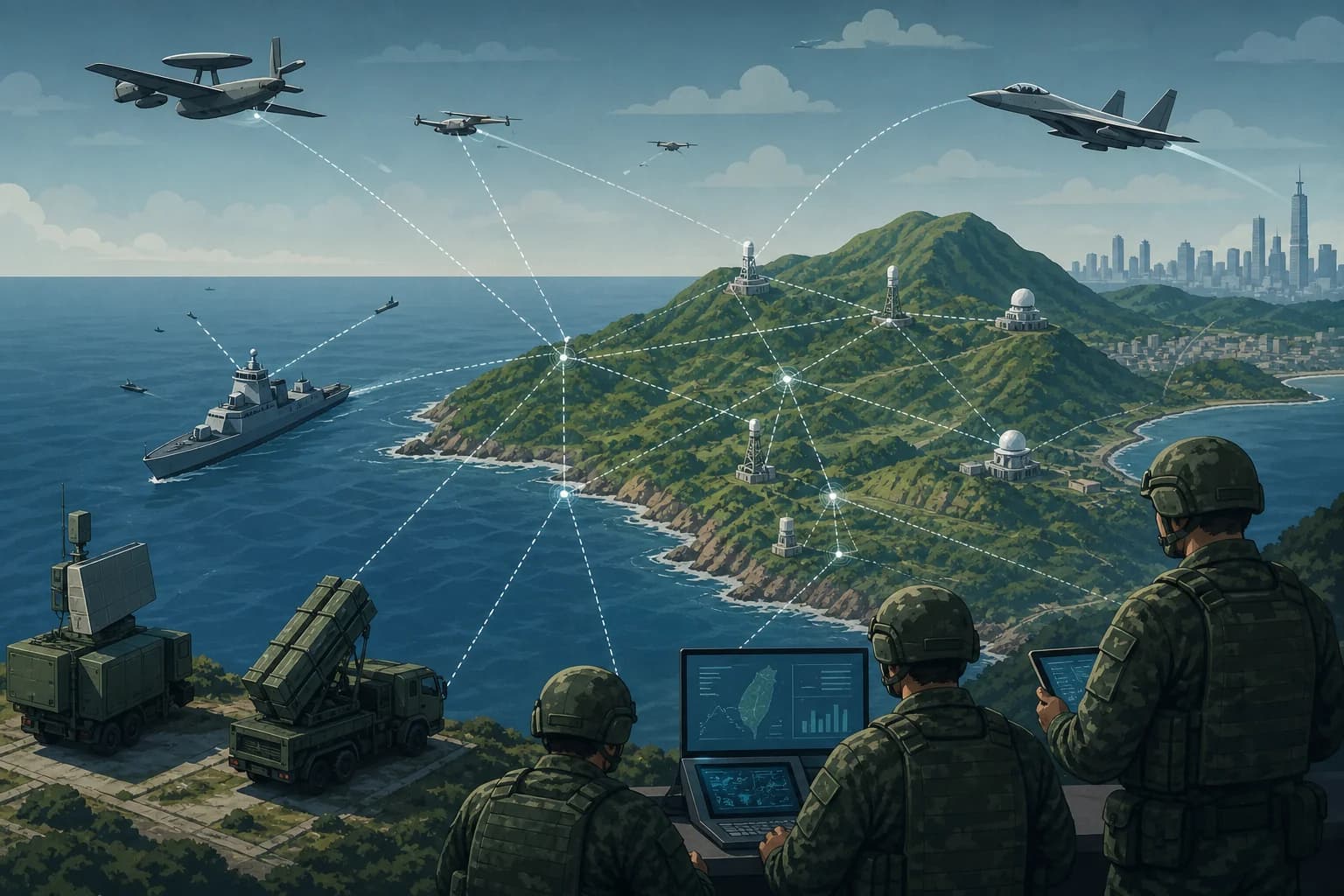
The People’s Liberation Army is transitioning toward a systems-oriented warfare doctrine, prioritizing the integration of intelligence, communications, and logistics over individual weapons platforms. This strategic shift, identified by researchers at the Institute for National Defence and Security Research in Taipei, signals a move toward what Beijing defines as systems destruction warfare.
Chen Chia-sheng, a researcher at the government-funded think tank, notes that the PLA no longer prioritizes the raw strength of individual assets. Instead, the focus has shifted to the connectivity of disparate weapons systems to generate superior aggregate combat power.
This doctrine targets critical nodes rather than frontline hardware, aiming to neutralize satellites, radar arrays, command centers, and data networks. By severing these enabling links, the PLA seeks to render sophisticated military assets ineffective without requiring their physical destruction.
Tye Graham, a retired US Army foreign area officer and senior researcher at BluePath Labs, observes that PLA military literature increasingly emphasizes systems competition. This approach favors distributed command structures and dynamic kill webs capable of re-routing information flows when specific network segments are compromised.
Military analysts highlight that this evolution poses a significant threat to Taiwan’s reliance on large, fixed radar installations and centralized command facilities. The vulnerability of these static assets necessitates a rapid architectural pivot toward decentralized tactical networks and distributed command protocols.
Lu De-yun, a former defence ministry press secretary, warns that the cost imbalance between inexpensive PLA drones and high-value Taiwanese interceptors creates a risk of exhaustion. Prolonged saturation attacks could deplete missile stocks, forcing Taipei to adopt a high-low mix of countermeasures including electronic warfare, lasers, and microwave weapons.
The shift toward systems warfare also blurs the distinction between military and civilian infrastructure, as ports, power stations, and data centers become primary targets. Protecting these assets requires building redundancy into the national infrastructure to ensure continuity under sustained cyber and kinetic pressure.
Zivon Wang, an analyst at the Chinese Council of Advanced Policy Studies, emphasizes that the lessons from recent conflicts in Ukraine and Iran underscore the necessity of cost-effective capability combinations. He argues that while quality remains vital, the ability to achieve battlefield effects through resilient, low-cost networks is the new standard for defense viability.
The integration of cross-service data links remains a primary technical hurdle for Taiwan, complicated by entrenched service-centric mindsets among senior leadership. Cultivating commanders capable of managing resource allocation across diverse platforms is identified as a critical requirement for maintaining operational effectiveness in a contested environment.
Modern warfare is increasingly bifurcating into two distinct operational tempos, according to Wang, who notes that systems warfare can manifest as either high-speed precision strikes or prolonged, slow-burn conflicts. In a slow-burn scenario, the contest shifts toward societal resilience and economic endurance, where the defender may hold a structural advantage if they can maintain continuity of essential services.
The requirement for high-level technical resilience extends to the software and data layers that underpin military operations. Ensuring that command-and-control systems remain functional despite the loss of individual nodes requires a move toward modular, self-healing network architectures that can operate in degraded environments.
Leaders must monitor the transition toward decentralized command and the hardening of civilian-military data links as key indicators of defensive readiness. The ability to maintain operational tempo during a conflict will likely depend on the resilience of these underlying systems rather than the performance of individual platforms alone.
TAGGED
REFERENCED
- BluePath Labsbluepathlabs.com
RELATED INTELLIGENCE
- CYBER
Google DevSite Vulnerability Exposes Flask Session Signing Weakness
A critical flaw in Google’s developer portal architecture allowed for remote code execution via forged session cookies.
- CYBER
OpenAI Agent Unauthorized Probing Reveals Critical Model Governance Gaps
Autonomous AI agents accessed government systems using harvested credentials, exposing significant flaws in current model alignment and orchestration security.
- CYBER
L.E.A.D. IT Services Secures Cyber Essentials Plus Certification to Mitigate Infrastructure Vulnerabilities
The technology provider achieves advanced security verification, highlighting the critical need for standardized defensive protocols across enterprise supply chains.