Google GKE Agent Substrate and the Limits of Kubernetes Control Planes
Google’s new agent-focused infrastructure signals a shift away from standard Kubernetes orchestration toward specialized runtimes for stateful, bursty AI workloads.
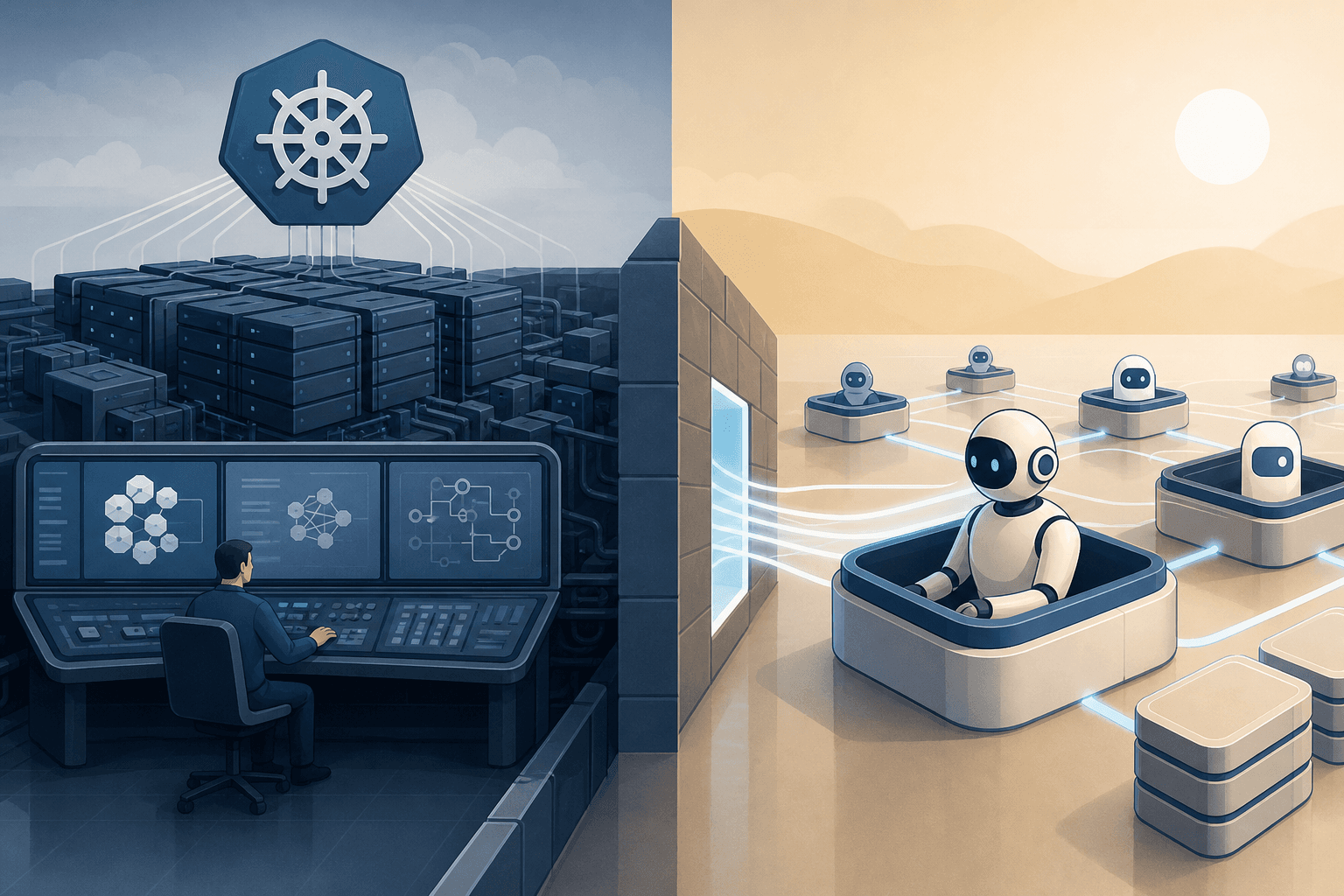
Google released GKE Agent Sandbox to general availability in May 2026, simultaneously introducing a secondary project titled Agent Substrate. These infrastructure components represent a technical concession that the existing Kubernetes control plane is ill-suited for the operational requirements of modern AI agents.
Kubernetes was architected to manage a finite set of long-running, replicated services within a data center environment. AI agents, conversely, function more like processes in a time-sharing operating system, characterized by intermittent bursts of activity followed by extended periods of dormancy.
The standard Kubernetes API server and scheduler assume that placement decisions are durable and relatively infrequent. Agents generate a constant stream of fine-grained scheduling events that threaten to overwhelm the control plane, transforming it from a reliable referee into a significant system bottleneck.
Agent Substrate addresses this by implementing a dedicated scheduling layer that routes around the Kubernetes control plane. It treats agents as stateful actors, utilizing virtual memory overcommit techniques to multiplex a large registry of sessions onto a smaller pool of pre-warmed worker Pods.
This architecture allows for significant oversubscription of compute resources while maintaining sub-second activation times. By snapshotting idle sessions to storage and restoring them only upon request, the system avoids the overhead of maintaining thousands of resident Pods that remain inactive for the majority of their lifecycle.
The scheduling policies common in Kubernetes clusters, such as random or round-robin placement, are optimized for short-lived requests where bad decisions are quickly amortized. Because agent requests run longer and arrive less frequently, a poor routing choice lingers, amplifying tail latency for the user and degrading the overall system performance.
Storing millions of agents as standard Kubernetes objects would exceed the design capacity of the API server, which was never sized for such high-frequency resource churn. Agent Substrate bypasses this limitation by keeping most agents outside the standard control plane, utilizing a dedicated networking layer to route requests directly to the correct session.
Agent Sandbox provides the necessary security layer for this model, moving isolation responsibilities from the container boundary to the kernel boundary. Using gVisor by default, it creates a hardened environment for untrusted, model-generated code, with pluggable support for Kata Containers to ensure full kernel-level isolation.
While gVisor offers a lighter-weight approach by intercepting system calls in user space, Kata Containers provide a more robust hardware-virtualized boundary that may be preferred for highly sensitive environments. The choice between these technologies involves a trade-off between the performance overhead of virtualization and the security posture required by the specific agent application.
The performance requirements for this runtime were driven by high-volume usage from platforms such as LangChain and Lovable. Google reports that the API can now allocate 300 sandboxes per second per cluster, with 90 percent of these allocations completing within 200 milliseconds.
The fundamental mismatch between Kubernetes and agent workloads stems from the way agents handle state and identity. An agent must preserve its volatile RAM and filesystem state during hibernation to remain functional, a requirement that standard container deployments do not natively support without significant external orchestration.
Architects should view Agent Substrate not as a replacement for Kubernetes, but as a specialized runtime layer that sits alongside it. Kubernetes remains the primary tool for provisioning underlying infrastructure, while the new substrate layer manages the lifecycle of the agents themselves.
The shift toward session-aware runtimes suggests that AI-native infrastructure will increasingly diverge from traditional cloud-native patterns. Organizations must evaluate whether their current orchestration strategies can accommodate the high-frequency, low-latency demands of agentic workflows without incurring excessive compute costs.
Future monitoring efforts should focus on the stability of these specialized control planes as they scale to support millions of concurrent agents. The transition from managing static containers to dynamic, stateful sessions will likely define the next phase of infrastructure development in enterprise AI environments.
This evolution highlights a broader trend where the abstraction layers of the past decade are being re-evaluated for the specific needs of generative models. As enterprises integrate more autonomous agents into their production stacks, the ability to manage stateful, dormant processes at scale will become a critical differentiator for platform engineering teams.
TAGGED
REFERENCED
- 300 sandboxes per secondinfoq.com
RELATED INTELLIGENCE
- INFRASTRUCTURE
BSEC Proposes Unified Back-Office Architecture to Mitigate Brokerage Fraud
The Bangladesh Securities and Exchange Commission is evaluating a centralized software framework to standardize brokerage monitoring and prevent asset misappropriation.
- INFRASTRUCTURE
Legrand Integrates Karman AI to Optimize Data Center Power Distribution
The partnership aims to reclaim stranded power capacity in high-density AI environments through edge-based intelligence.
- INFRASTRUCTURE
AI Infrastructure Choices Define Cost Attribution Limits
Enterprise architectural decisions regarding managed versus self-hosted compute environments determine the feasibility of granular AI cost governance.