Standardizing LLM Infrastructure for Enterprise Reliability
Transitioning from fragmented AI application development to a centralized platform model reduces hallucination rates and improves operational visibility.
Enterprise organizations deploying large language models often encounter a predictable failure cycle where initial prototypes succeed, but production environments suffer from silent semantic degradation and uncontrolled token consumption. Aditya Mulik, an engineer working on inventory accuracy systems, identified that treating LLM integration as an application-specific concern creates technical debt that scales poorly across multiple teams.
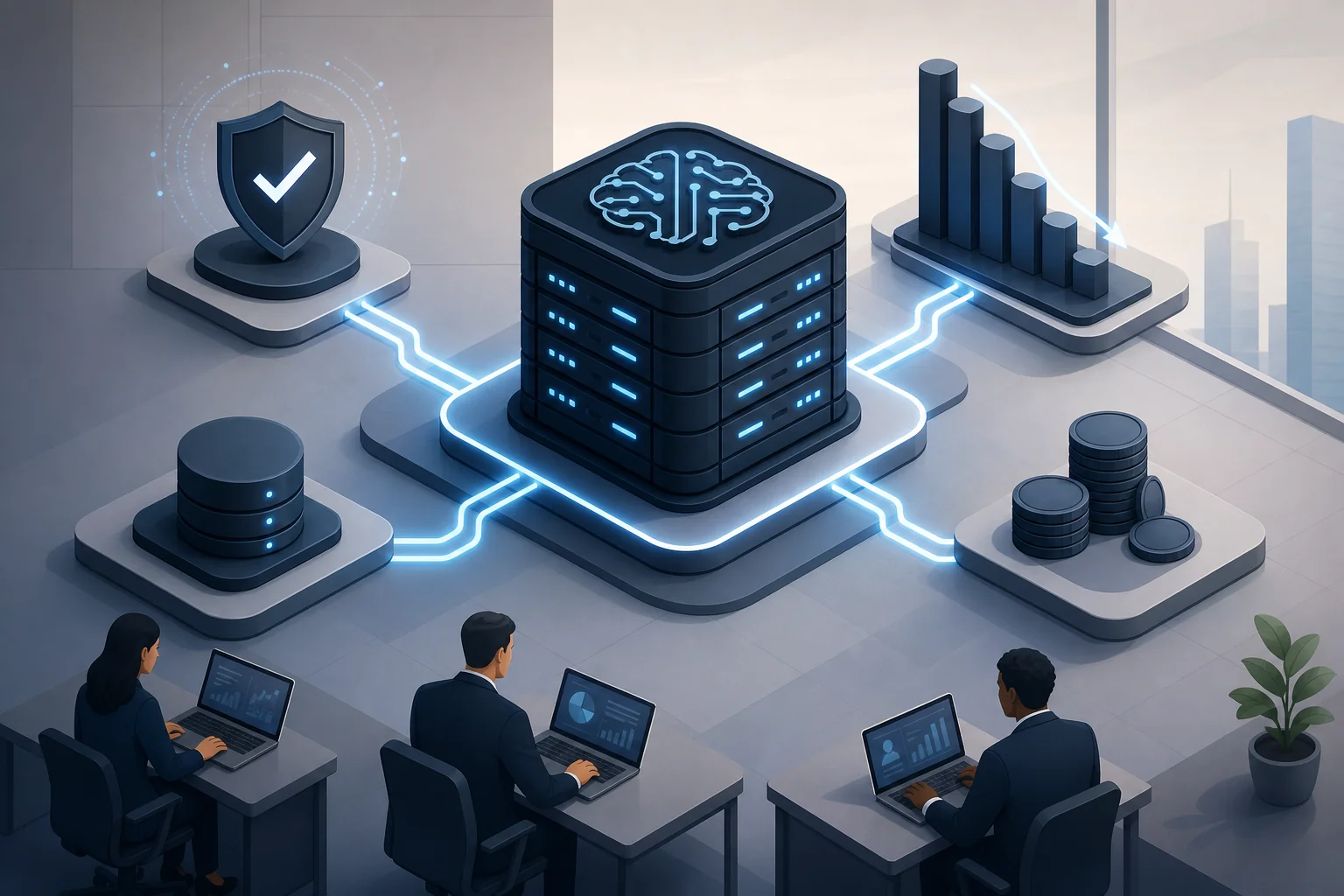
The shift toward a shared platform infrastructure model allows organizations to move beyond basic health checks and address the specific challenges of non-deterministic AI outputs. By implementing a centralized gateway, engineering teams can enforce uniform schema validation, prompt versioning, and request-level cost attribution. This architectural transition mirrors the evolution of service mesh and centralized authentication patterns in traditional distributed systems.
Hallucination rates in production environments are often controllable through automated retry loops that intercept formatting and grounding errors before they reach downstream services. Mulik reported that implementing these platform-level guardrails reduced hallucination rates from fifteen percent to 1.5 percent within six months. This approach treats model output as a data stream requiring validation rather than a black-box response.
The retry mechanism functions by parsing the model output against a predefined schema and automatically re-prompting the model if the response fails validation or lacks grounding in the provided context. This loop executes at the platform layer, ensuring that the application logic remains decoupled from the specific error-handling requirements of the underlying foundation model.
Intent-validation gates serve as a critical component in multi-agent routing, ensuring that requests are directed to the correct specialist agent or returned as unclassified. This prevents the system from defaulting to high-scoring agents that may lack the specific context required for a task. Centralizing this logic within a root coordinator agent simplifies the topology and reduces redundant code across application teams.
Prompt management requires a history-preserving registry to enable instant rollbacks and auditable instruction changes. Hardcoding prompts into application files obscures behavioral changes and prevents teams from maintaining a clear audit trail of model instructions. A centralized registry allows for runtime updates without requiring full application redeployments.
Tool authorization must be enforced at the resource server level rather than relying solely on API gateway checks. A default-deny policy ensures that vulnerabilities in the orchestration layer do not expose connected tools to unauthorized access. This security posture is essential for maintaining compliance in enterprise environments where LLMs interact with sensitive supply chain or inventory data.
Standard application performance monitoring tools frequently fail to detect semantic drift because they focus on latency and traditional error rates. Effective observability requires instrumenting hallucination rates and per-team token costs at the point of request ingress. Retrofitting these metrics after the system is in production often requires significant engineering resources that could be avoided with upfront platform design.
The decision to build a shared LLM platform should occur before the second or third model-driven feature reaches production. Waiting until ten or more teams have implemented fragmented solutions creates a migration burden that complicates long-term maintenance. A platform contract allows applications to declare requirements while the infrastructure handles the complexities of model execution and evaluation.
Architects should monitor the emergence of standardized agent development kits that facilitate this modular approach to LLM orchestration. The primary risk remains the potential for vendor lock-in if the platform layer is too tightly coupled with a single foundation model provider. Future-proofing the stack requires maintaining the ability to swap models through abstraction layers like LiteLLM while keeping the core platform logic independent of specific model weights.
Leadership teams must prioritize the creation of a centralized LLM registry and observability dashboard to gain visibility into token spend and behavioral quality. Establishing these primitives now will prevent the accumulation of technical debt as AI-driven features proliferate across the enterprise. The focus must remain on building stable, auditable, and scalable infrastructure that treats AI as a standard component of the modern data stack.
TAGGED
REFERENCED
- service meshaws.amazon.com
- application performance monitoringdynatrace.com
- LiteLLMgithub.com
RELATED INTELLIGENCE
- INFRASTRUCTURE
BSEC Proposes Unified Back-Office Architecture to Mitigate Brokerage Fraud
The Bangladesh Securities and Exchange Commission is evaluating a centralized software framework to standardize brokerage monitoring and prevent asset misappropriation.
- INFRASTRUCTURE
Legrand Integrates Karman AI to Optimize Data Center Power Distribution
The partnership aims to reclaim stranded power capacity in high-density AI environments through edge-based intelligence.
- INFRASTRUCTURE
AI Infrastructure Choices Define Cost Attribution Limits
Enterprise architectural decisions regarding managed versus self-hosted compute environments determine the feasibility of granular AI cost governance.