Debugging Kubernetes Networking: The Shift from Iptables to Nftables
Infrastructure architects must navigate the transition from legacy iptables to the nftables kernel engine to resolve persistent networking failures in containerized environments.
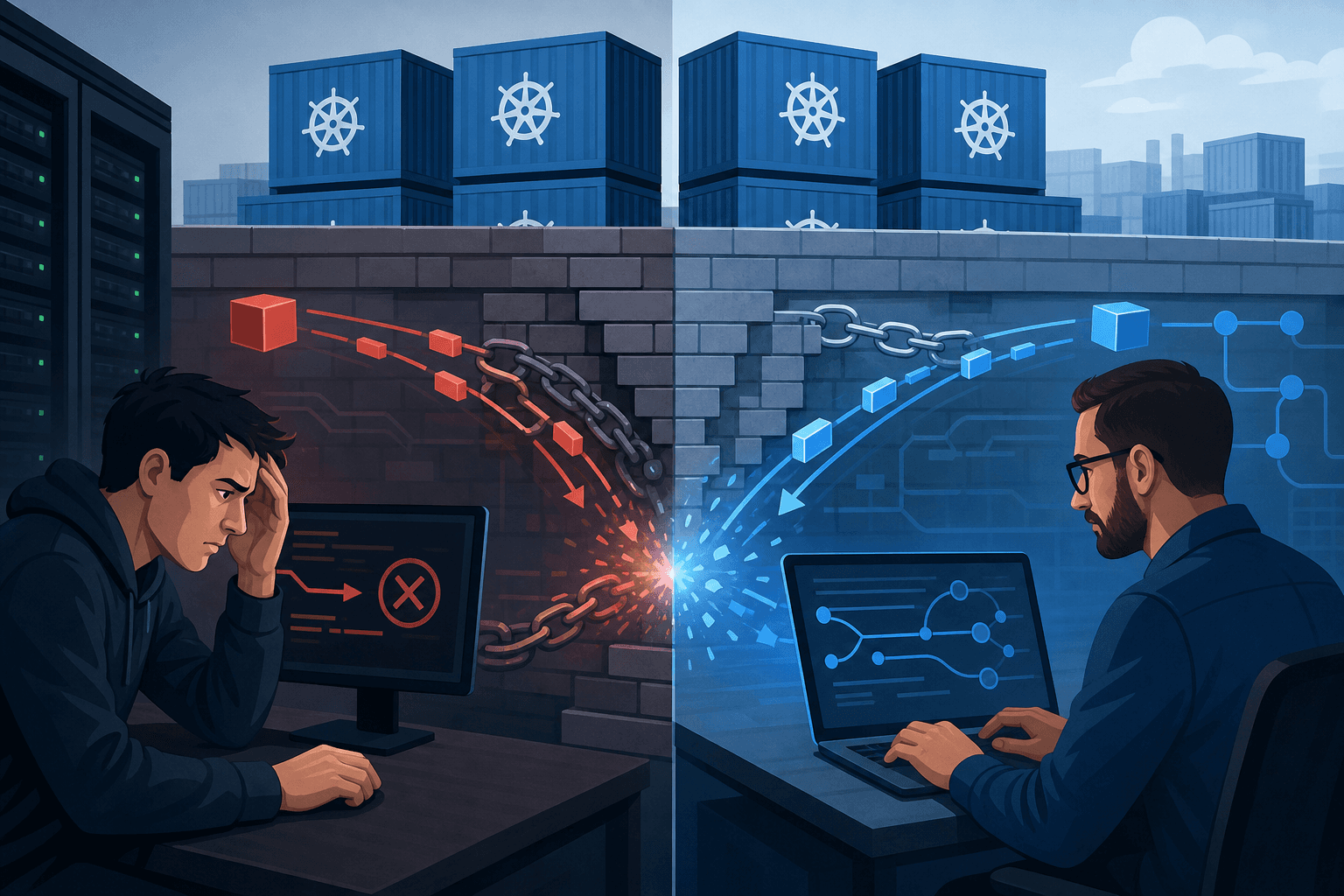
A recent infrastructure failure on an NVIDIA Jetson device running k3s at the edge exposed a critical disconnect between Kubernetes abstraction layers and the underlying Linux kernel networking stack. The svclb-traefik service entered a persistent CrashLoopBackOff state despite valid manifests and successful image pulls, pointing to a failure in packet classification rather than orchestration logic.
Netfilter serves as the foundational kernel subsystem for Linux networking, providing five distinct hook points—PREROUTING, INPUT, FORWARD, OUTPUT, and POSTROUTING—where packets are intercepted for verdict processing. These hooks operate independently of specific protocols, relying on registered callbacks to determine whether a packet should be accepted, dropped, or queued for further inspection.
Packet classification occurs at these hooks by evaluating packet header fields against defined rules to reach a verdict. Traditional iptables utilizes a linear-evaluation engine, which scans rules sequentially in an O(n) complexity model, whereas modern nftables employs an indexed-evaluation engine that utilizes hash tables and interval trees to achieve near-constant time performance.
The historical fragmentation of Linux networking tools—including iptables, ip6tables, arptables, and ebtables—stemmed from protocol-specific implementations that lacked shared rule sets or unified syntax. This architectural separation often complicates Kubernetes CNI deployments, where bridge-mode networking requires coordination across both Layer 2 and Layer 3 traffic paths without a centralized engine.
Modern Linux distributions have largely transitioned to using iptables-nft, a compatibility shim that translates legacy syntax into nftables bytecode to leverage the more efficient virtual machine architecture. This abstraction layer allows users to maintain familiar workflows while benefiting from the performance and scalability improvements inherent in the nftables framework.
The specific failure on the Jetson device underscored the risks of relying on legacy kernel modules in constrained environments where vendor-specific configurations may conflict with default networking assumptions. Blacklisting the nf_tables module effectively forced the system to revert to legacy behaviors, highlighting the necessity of understanding the underlying kernel state when high-level orchestration tools fail to provide actionable diagnostic data.
Performance metrics reveal that while iptables incurs significant latency as rule counts scale into the thousands, nftables maintains stability through its bytecode virtual machine. By offloading complex CIDR comparisons to set-membership tests, the kernel reduces CPU cycles per packet, which is vital for edge devices with limited compute resources and high-throughput requirements.
Linear evaluation remains a significant source of operational friction, as rule order dictates outcomes rather than rule specificity. In large-scale clusters, the absence of an automatic resolution mechanism for conflicting rules often leads to silent packet drops that are difficult to trace through standard container logs or Kubernetes events.
Architects must recognize that the transition from iptables to nftables is not merely a performance upgrade but a fundamental change in how the kernel processes network traffic. The shift toward indexed evaluation reduces the overhead of complex rule sets, yet it introduces new variables in how connection tracking and NAT are handled across different kernel versions.
Infrastructure teams should prioritize auditing their CNI configurations to ensure compatibility with modern nftables implementations. Monitoring for discrepancies between user-space rule definitions and kernel-level execution remains essential for maintaining network stability in edge-computing environments where kernel updates are often managed by hardware vendors rather than platform engineers.
Future stability hinges on the industry-wide move toward eBPF for packet processing, which promises to further decouple networking logic from the constraints of the traditional netfilter stack. Organizations should prepare for this shift by evaluating the maturity of their current networking plugins and identifying potential points of failure within their existing kernel-level abstraction layers.
Ongoing maintenance of these systems requires a deep understanding of the interaction between the kernel VM and the CNI-generated rules. As Kubernetes continues to abstract away the network layer, the ability to debug at the kernel interface remains a critical skill for platform engineers tasked with maintaining high-availability clusters.
TAGGED
REFERENCED
RELATED INTELLIGENCE
- INFRASTRUCTURE
BSEC Proposes Unified Back-Office Architecture to Mitigate Brokerage Fraud
The Bangladesh Securities and Exchange Commission is evaluating a centralized software framework to standardize brokerage monitoring and prevent asset misappropriation.
- INFRASTRUCTURE
Legrand Integrates Karman AI to Optimize Data Center Power Distribution
The partnership aims to reclaim stranded power capacity in high-density AI environments through edge-based intelligence.
- INFRASTRUCTURE
AI Infrastructure Choices Define Cost Attribution Limits
Enterprise architectural decisions regarding managed versus self-hosted compute environments determine the feasibility of granular AI cost governance.